
Throwing Children to the Wolves
The Conversion Practices Bill: Criminalising Parents, Teachers and Priests
Lucy Beney
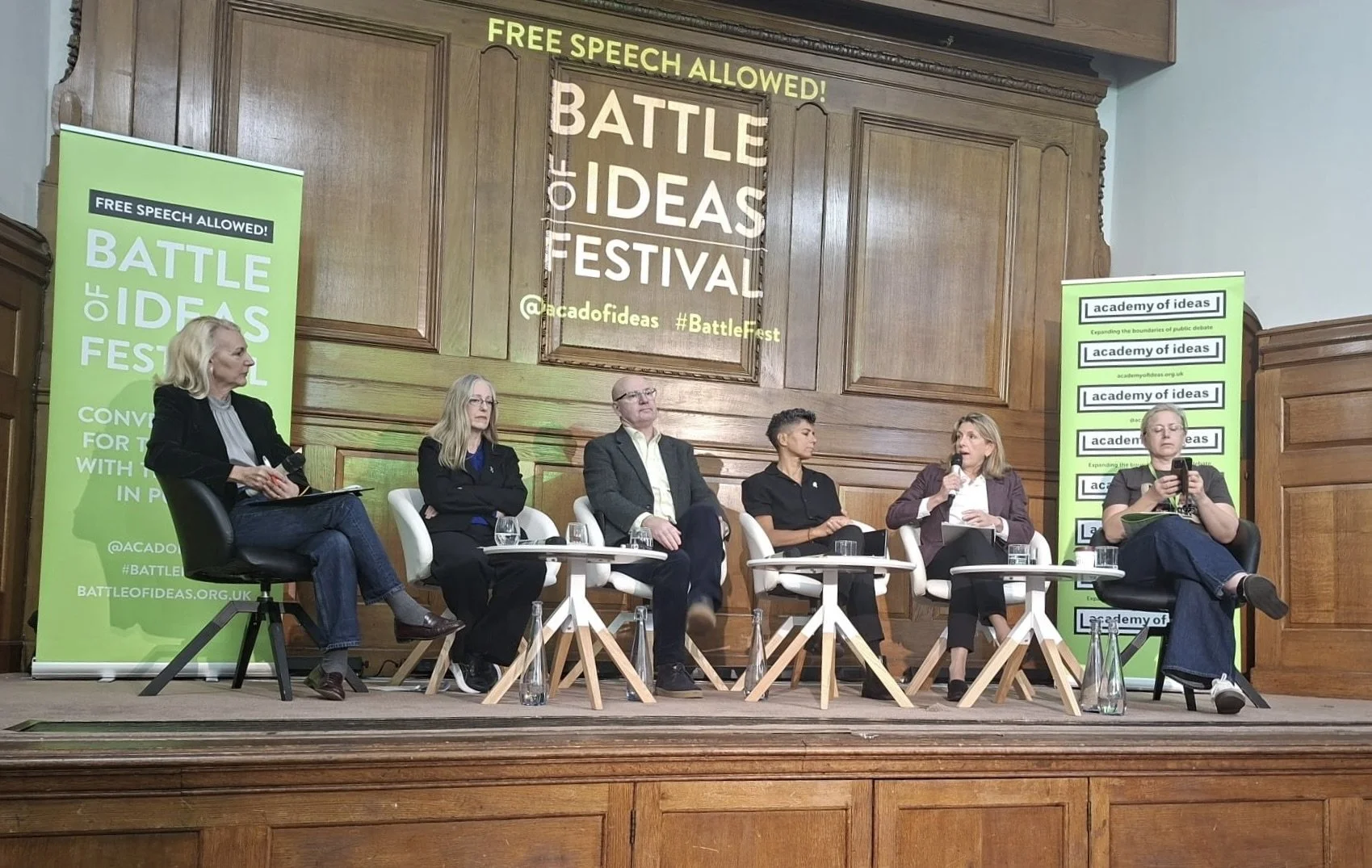
This is a transcript (with a few minor edits) of my contribution to a panel at the 2026 Battle of Ideas Festival in London. We were discussing the clear and present dangers embedded in UK’s draft Conversion Practices bill.
The panel was chaired by Jan Macvarish, from the Free Speech Union (FSU), and included talented, compassionate and committed campaigners Helen Joyce, Neale Hanvey, Faika El-Nagashi and Sarah Phillimore.
After touching on the alleged problems the bill is aiming to solve, who is likely to be ‘criminalised’ and some background to this legislation, Jan Macvarish asked me: What do adults ordinarily do for a young person who is unsure of who they are, and what happens to that role under the draft bill?
This is what I said:
It is important, first, to say something very quickly about identity formation. Historically and traditionally, our identities start to form at the very earliest at age. They are influenced by family, community, faith and the people around us. As we grow, this is augmented by our experience of life, our talents, our preferences and other influences.
The idea is that when you get to adolescence, which is the point at which I would say you lose the ‘all things are possible’ of childhood – we all know that a child can want to be a train driver in the morning, perform surgery on their fluffy toys at lunchtime and by the evening, they are a disco princess – and reality should kick in. We don’t lose the dreams and the fantasies of the person that we could become, but it becomes grounded in reality.
This is one of the reasons why so many people seem keen to prevent puberty from happening. The focus has been on secondary sexual characteristics but in fact puberty is a whole body-and brain-process.
In recent years, those original influences on identity have weakened. Families are not so strong, communities have fallen apart and a lot of people don’t practise any faith. At the same time, there is a concerted effort to put in the minds of children what I call the ‘false creations of a heat oppressed brain’, which are the lengthy lists of fictitious genders and sexualities. Children are not rooted in perhaps the way they once were, but they are now exposed to “you could be this, you could be that” – and this is happening in schools. People are going into schools under the guise of personal, social and health education (PSHE), and relationships and sex education (RSE) and suggesting to seven-year-olds that the ‘genderbread person’ means that you might have been born in the wrong body – which is not possible.
So that is the background, and the way that I have always worked with children who are confused about identity and gender is – you open it out. It is not just about your gender or your sexuality. Human beings are multi-faceted creatures. There are all sorts of things which feed into identity. The sad outcome of what I just described above, and putting all these ideas into children’s heads, is this – quite often, when you meet a child for the first time, and say tell me about yourself, they’ll say “Well, I’m non-binary and I’ve got ADHD, I’m this, I’m that…”.
And I say, “No, tell me about yourself. What do you like to do? Tell me about your family, tell me about your pets”, but all of that is regarded as irrelevant when it comes to transgender identification, as is the ability to work with stories – there is always a reason why a child is uncomfortable with their body, rejects their body. It doesn’t matter whether this manifests as anorexia, or as self-harm. If you turn against your body, if you are uncomfortable in your body, to me it is always indicative that there is something else happening. And when you explore – now – these stories, you will often find out what is going on.
You will find the girl who doesn’t want to grow up, because she has witnessed domestic or sexual violence. Pornography is a huge thing in all of this, both for boys and girls. There are girls who say: “If that is what being an adult woman means – forget it. The way I can protect myself is to be non-binary, because then I can stay in fairy land and I can be a glitter person”.
Boys – often boys who have grown up with a single mother, or with sisters – they look at pornography and they think: “I’m not ever doing that to a woman. If this is what being a man is, I don’t want to be one”.
Unless you can talk to children and find out the story, talk about what is going on and show them a different way – then there’s very little chance of either addressing the underlying problem or of saving them from going down a pathway which is not like other sociogenic fads of the past. It will actually ruin their health longterm. The likelihood is it will ruin their chances of growing healthily, having a healthy family of their own and having a healthy sexual relationship. All of that can only be addressed, if you can talk about the backstory.
And effectively what happens under this bill is – you ‘fix’ children at a point in time. So a child comes and says “I think that I am whatever”, and this bill obliges you to take that child at face value. You are fixing them at a point in time.
I remember my grandmother saying: “If you make a stupid face and the wind changes, you are going to be stuck like that” and this analogy keeps coming back to me. If you can’t address what is going on, you can’t look at the backstory you are effectively fixing a child at a point in time – and often at a time when their identity, their feelings about themselves are most fluid. They are experimenting with things. They need containment, they need kick-back from adults, they need adults to say “no” – “no, that isn’t true”, or “no, that isn’t right” – and everything about this bill means that this will no longer be possible.
I can’t help feeling that the people who produced this either deliberately ignored, or have zero experience of, family life. What about siblings? I’ve met a number of children who have said: “I’ve got an obnoxious homophobic/transphobic brother” – who is 11. Is this person going to be pursued by the police, the courts, social workers? And this is often the kind of remark that children make when they are angry, when they are upset. It is bringing the law into the most intimate family spaces. As has already been mentioned, it could be used as a weapon against parents, grandparents, cousins, brothers and sisters – whoever.
And it reflects a belief system. You hear talk that this is ‘progressive’, that this is the way to go. In fact it puts me in mind of something very Medieval – this is a belief system that we are required to adhere to; there are penalties for heresy; we rather like the idea of the mortification of the flesh; and children are the sacrificial victims.
I will just end with a very brief composite case study. I had the pleasure of meeting a young man when I was working in school, who on our first meeting declared himself a to be a “gender-fluid, polyamorous pansexual” (at this point there was laughter in the hall). It is desperately serious, but sometimes it is difficult not to laugh, when you hear this from a child – and he was a child. This was not somebody who had fully gone through puberty. I said “Tell me about this”.
He said he was gender-fluid because he had no interest in football – all his friends liked football and therefore he was somehow ‘weird’. He thought he was a boy, but maybe he wasn’t a ‘real’ boy – you get the picture. Polyamorous – because he hoped in his life to have more than one girlfriend before he got married; and he was a ‘pansexual’ because emotional connection was important to him and he didn’t just want to go for somebody simply on the basis that they looked ‘hot’.
Now this was a serious boy who had obviously spent a lot of time going through all sorts of stuff on the internet. So many children do this – “Oh I’m this, Oh I’m that” and then they get anxious because, “Maybe I picked the wrong one”, or my friend is something different”. You know, it really is at that level.
This boy complained of sibling transphobia, because his older brother didn’t accept that he was what he had declared he was. In this case, the family was very sensible. The mum and dad put their arms around the young boy and said: “Look, get off the internet, stop looking at this stuff, things will work themselves out. You know, you are just an ordinary boy, with ordinary feelings, going through this stage in your life”. And they told the older brother to lay-off, and stop winding him up. And believe it or not, things resolved themselves.
But all of that is at risk. All the people involved in that – the parents, the brother, myself as a professional, teachers, other support workers – could all be at risk for challenging what I’m sure you will agree is a quite absurd assertion by a child.
This is what is at risk.
In response to questions from the floor about the influence of ‘queer theory’ and the effects on religious believers: Just very quickly, on the whole idea of ‘queer theory’ taking over everything – I was at an interesting session yesterday on indoctrination in education. It is very clear is that a lot of this is emanating from the water that we swim in. This also partly answers the question about same-sex attracted young people being ‘transed’ – when they have grown up in an environment where there is no truth but my truth, where there is no reality, your reality and my reality can be two different things, it would become very difficult to prove, I think, that they had been ‘converted’. This is why they are starting this [indoctrination] in schools with very young children.
On the matter of religion and faith, it [the draft bill] is a very serious concern, I think. Interestingly the Roman Catholic Diocese of Nottingham, a couple of years ago, put out some very thoughtful guidance on working with trans-identifying, children but presumably all that pastoral, caring work would fall short of [the requirements of] this bill. I am rather disappointed that the Church of England hasn’t spoken up about it, given that the bill attacks the very foundation of faith. I think we have to look at the background environment this has come from, and that gives us an idea of the scale of the challenge.
And my closing remarks:
I would just say that it represents the most grotesque abandonment of some of the most vulnerable young people and children you could imagine – those who have suffered trauma, those who have various diagnoses of neurodivergence, those who are same-sex attracted, those who are lonely, afraid and spend lots of time on the internet. We are throwing them to the wolves. It is an utter disgrace and we have to do everything we can to stop the bill.

Lucy Beney, Save Mental Health’s Correspondent on Child Mental Health.
Lucy, of Thoughtful Therapists is an Integrative Counsellor working in private practice and also a facilitator for the Tuning into Teens parenting programme